Why We Should Adopt Babies for Usa People
The New Question Haunting Adoption
At a glance, America'due south shortage of adoptable babies may seem similar a trouble. Only is adoption meant to provide babies for families, or families for babies?
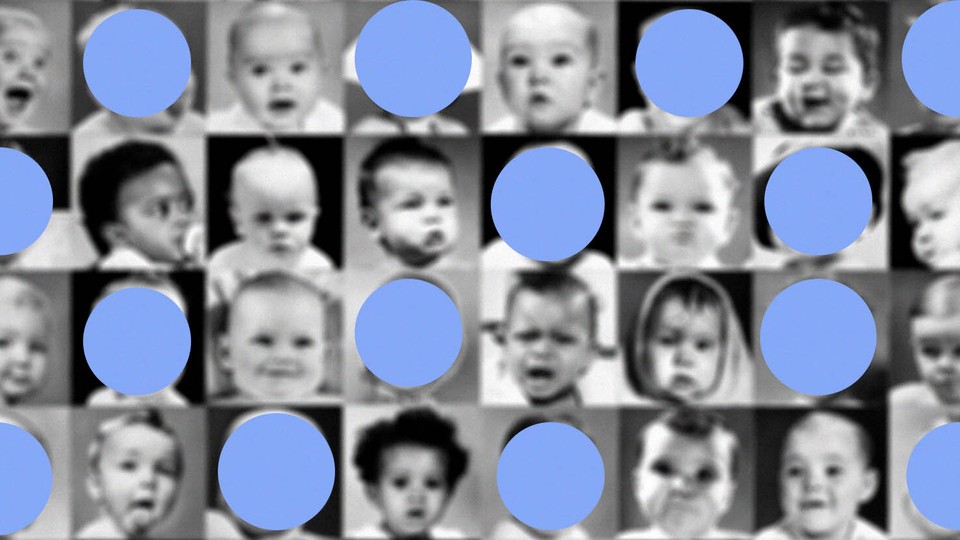
Ever since I entered what can generously be called my "mid-30s," doctors take asked near my pregnancy plans at every appointment. Because I'k career-minded and generally indecisive, I've always had a fashion of punting on this question, both in the dr.'s function and elsewhere. Well, we can always adopt, I'll call up, or say out loud to my similarly childless and wishy-washy friends. Adoption, after all, doesn't depend on your oocyte quality. And, as we've heard a million times, there are so many babies out at that place who need a good home.
Just that is not actually truthful. Adopting a baby or toddler is much more difficult than it was a few decades ago. Of the nearly 4 million American children who are born each year, only about eighteen,000 are voluntarily relinquished for adoption. Though the statistics are unreliable, some estimates suggest that dozens of couples are now waiting to adopt each available infant. Since the mid-1970s—the end of the so-called baby-scoop era, when large numbers of single women placed their children for adoption—the pct of never-married women who relinquish their infants has declined from nearly 9 percent to less than ane percent.
In 2010, Bethany Christian Services, the largest Protestant adoption agency in the U.S., placed more than 700 infants in individual adoptions. Last year, it placed fewer than 300. International adoptions have non closed the gap. The number of children American parents adopt each year from abroad has declined rapidly too, from 23,000 in 2004 (an all-time high) to about three,000 in 2019.
Plenty of children who aren't babies need families, of course. More than 100,000 children are available for adoption from foster care. Just adoptive parents tend to prefer children who are what some in the adoption earth call "AYAP"—equally immature as possible. When I recently searched AdoptUSKids, the nationwide, authorities-funded website for foster-care adoptions, only virtually twoscore kids under age 5, out of the four,000 registered, appeared in my search. Many of those 40 had extensive medical needs or were part of a sibling group—a sign that the child is in even greater need of a stable family, but also a more challenging experience for their adoptive parents.
At a glance, this shortage of adoptable babies may seem similar a problem, and certainly for people who desperately want to adopt a infant, it feels like one. But this trend reflects a number of changing social and geopolitical attitudes that take combined to shrink the number of babies or very young children available for adoption. Over the by few decades, many people—including those with strong commitments to the idea of baby adoption—have reconsidered its value to children. Though in the short term this may be painful for parents who wish to prefer infants, in the long term, it might exist ameliorate for some children and their nativity families. Many babies in the developing world who once would take been brought to America will now be raised in their home state instead. And Americans who were planning to adopt may have to refocus their energies on older, vulnerable foster children—or modify their plans entirely. Baby adoption was once seen as a heartwarming win-win for children and their adoptive parents. It'due south non that elementary.
For much of American history, placing a child for adoption was an obligation, not a pick, for poor, single women. In the decades later on Earth War II, more than 3 one thousand thousand young pregnant women were "funneled into an often-coercive organization they could neither understand nor resist," Gabrielle Glaser wrote in her recent volume, American Infant. They lived with strangers as servants or were hidden away in maternity homes until they gave birth, at which time they were pressured into closed adoptions, in which birth mothers and their babies have no contact.
Data on adoption are and have always been fuzzy and incomplete; for decades, no one tracked many of the adoptions that were happening in the U.S., and not all states reported their adoption figures. "There are no valid numbers from the '40s and '50s" because "only near all of these transfers existed in a realm of secrecy and shame, all around," the historian Rickie Solinger told me. However, adoption researchers generally agree that adoptions of children by people who aren't their relatives increased gradually from well-nigh 34,000 in 1951 to their peak of 89,000 in 1970, before declining to about 69,000 in 2014—a number that includes international adoptions and foster-care adoptions. Given population growth, the decline from 1970 indicates a 50 percent per capita subtract.
What happened? Starting in the '70s, single white women became much less probable to relinquish their babies at birth: About a fifth of them did so before 1973; past 1988, just iii percent did. (Single Black women were always very unlikely to place their children for adoption, because many maternity homes excluded Black women.) In 1986, an adoption director at the New York Foundling Hospital told The New York Times that though "in that location was a time, about twenty years ago, when New York Foundling had many, many white infants," the number of white infants had "been very scarce for a number of years."
Still, throughout this era, American families adopted thousands of infants and toddlers from strange countries. In the '50s, a mission to rescue Korean War orphans sparked a trend of international adoptions by Americans. Over the years, international adoptions increased, and Americans went on to adopt more than than 100,000 kids from South Korea, Romania, and elsewhere from 1953 to 1991. In 1992, China opened its orphanages to Americans and immune them to accept in thousands of girls abandoned considering of the land's one-child policy.
But to many American evangelical Christians, these numbers were still too depression to combat what they considered to be a global orphan crisis. During the '90s, evangelicals in particular kindled a new strange- and domestic-adoption boom, equally the journalist Kathryn Joyce detailed in her 2013 book, The Kid Catchers, which was critical of the trend. In the late 1990s, Joyce reported, representatives from Bethany Christian Services and other adoption agencies occasionally pressured single women to relinquish their babies, gave them false impressions virtually the nature of adoption, and threatened them when they changed their mind. (Bethany cannot verify the negative accounts of its practices that appear in Joyce's book, Nathan Bult, the group'southward senior vice president of public and government affairs, told me. In an interview, Joyce stood past her reporting.) A major 2007 meeting of Christian groups led to a "campaign to enroll more Christians as adoptive and foster parents," the Los Angeles Times' Stephanie Simon reported that yr. The practice of adoption was seen equally parallel to evangelical Christians' "adoption by God" when they are born once more. American Christians went on to adopt tens of thousands of children from other countries. "Early, in that location was a potent belief that adoption could frequently be the all-time effect for a child whose mom may accept felt unable to parent," Kris Faasse, who ran several of Bethany's programs from 2000 to 2019, told me.
In recent years, though, international adoption has slowed to a trickle because of changes abroad and within American adoption agencies. During the foreign-adoption blast, almost of the children adopted from away establish happy homes in the U.S. Some, however, turned out to not really be orphans, just instead children placed in orphanages temporarily by their impoverished parents. This sparked reforms and had a spooky effect on their home countries' policies. Some of the most popular source countries for adoptable children—including Russia, Guatemala, and Federal democratic republic of ethiopia—shut down their adoption programs years ago because of corruption scandals or tensions with the U.S. government. Cathay expanded its domestic-adoption program and reversed its one-child policy in 2015, dramatically reducing the number of girls who were relinquished for adoption.
So, last twelvemonth, Bethany closed its international-adoption program, instead focusing on its in-country foster-care and adoption programs. (In other words, Ethiopians, non Americans, volition adopt Ethiopian children.) The Christian Alliance for Orphans, which helped launch the American Christian adoption boom 14 years agone, at present says that the priority in international adoption should be keeping a kid with her family or, failing that, placing her with a stranger in her home country, and taking the child abroad only if the beginning two options aren't available. "And always, always, in that order," Jedd Medefind, the president of the Christian Alliance for Orphans, told me recently.
Even Joyce, the Kid Catchers author and a critic of the evangelical adoption movement, says the groups take changed. About four years ago, Joyce appeared on a Christian Brotherhood for Orphans panel, and even and then she noticed more talk of family preservation. The adoption movement had seemingly grappled with the criticism, she told me. Plus, there are now so few international adoptions that, "on a practical level, it probably just doesn't make as much sense to have a motility that is advocating for that and then hard."
Every bit international adoptions accept declined, parallel cultural changes accept led to a reduction in American babies who would, in an earlier era, likely have been relinquished. The American birth charge per unit is at an all-time depression. Teens, who are less likely to be set to heighten children than older women, are getting pregnant at the lowest rates ever. Single motherhood is less taboo, then although unwed women, who were once more likely than married people to place their children for adoption, are at present having 40 per centum of all babies, for the most part they are choosing to raise their children themselves.
Some imagine that outlawing abortion might create a rise in adoptions, but that'due south unlikely. In one study, only 9 pct of the women who were denied an ballgame chose adoption. Even as single parenthood has go less stigmatized, placing a child for adoption has become more and then. Adoption is "an extremely rare pregnancy decision," Gretchen Sisson, a sociologist at the University of California at San Francisco, told me.
And in addition to rethinking international adoption, some groups are likewise reconsidering whether unmarried, poor American women should exist encouraged to place their babies for adoption. They seemed to have captivated the growing business organisation that people of colour are surrendering their children to white adoptive parents, the bad printing about families who weren't equipped to heighten their newly adopted children, and the idea that "families belong together" should apply to poor people likewise. Over the by xx years, "there was a shift," Faasse, the former Bethany staffer, told me, "toward ensuring that mom was fully informed of her options ... 'Allow'southward non but expect at what your decision is today, but what will it wait similar in the time to come?'"
Bethany is now trying to assist struggling American birth mothers parent their own children, as growing numbers of single women aim to practise. In 2019, the group created a special program for drug-fond nascence moms intended to assistance them stay with their babies. Some other program connects struggling nascence parents with supportive families, with the aim of preventing the removal of the birth parents' children. "At Bethany, we want to do all nosotros tin can do, first and foremost, to keep kids with their birth families when information technology is safe and possible to do so," Cheri Williams, Bethany'due south senior vice president of domestic programs, told me. The next best choice after that, she said, isn't adoption by strangers, merely rather by the kid's relatives.
These changes won't eliminate abuses within the adoption industry. A process that involves people surrendering their biological children is jump to be fraught. All the same, a single, pregnant adult female is likely to have a dissimilar experience with an system similar Bethany today than she would have decades ago. "Expanding the numbers of children who are adopted domestically, for the sake of expanding the numbers of children who are adopted domestically, is not something that nosotros want to be doing," Bult, at Bethany, told me. "An expectant mom should never be coerced into making an adoption plan for her child," he added.
To adoption reformers, the practice is now largely seen as a way to provide families for older, special-needs children rather than a way to provide salubrious babies to people who desire to parent. The consequence is often a difficult, expensive procedure for couples who want to adopt a infant or toddler. Adopting a newborn can cost $45,000 or more. "There is increasingly an advertising bid war to find birth parents," Daniel Nehrbass, the president of Nightlight Christian Adoptions, told me. A cottage manufacture of adoption "facilitators" has sprung upwards that "may accuse $25,000, which is basically an advert fee to the family unit in gild to detect the birth mom."
Though adoption experts told me that virtually people who pursue infant adoption are ultimately successful, some spend their savings to do it or await years to adopt: One survey found that 37 per centum of adoptive families wait longer than a twelvemonth. Others encounter scams or nascence mothers who change their mind. The journalist Erika Celeste had been trying to adopt a babe girl for years when she was tricked by Gabby Watson, a notorious adoption scammer who posed as a pregnant adult female and strung along hundreds of hopeful families. Nearly every adoptive parent I interviewed for this story said that the grueling process was worth information technology in the end—even though "the end" invariably came later on an emotional spin cycle.
But aspiring adoptive parents who are disappointed by a hard organisation might not get the chance to run across the other side of these changes—the one in which poor, single women get to parent their own babies, even if they never thought they could. Bult introduced me to Brijon Ellis, a 24-yr-former in Ypsilanti, Michigan, who exemplifies this shift. When Ellis got significant at 15, she told me, a family unit member pressured her into placing her girl into a closed adoption through Bethany. Subsequently signing the adoption paperwork, Ellis remembers crying so hard in the infirmary that her face swelled.
Three years later, at 18, Ellis got meaning again, this fourth dimension with twins. Ellis chosen Dawn, the same Bethany social worker who had arranged her girl's adoption, to learn about her options. Simply this time, whenever Dawn mentioned adoption, Ellis grew teary-eyed and equivocal. Dawn picked upward on her reluctance, Ellis said.
Instead, Dawn told her about Safety Families, a Bethany program that gives struggling birth parents clothes, food, child intendance, and other back up. Ellis carried her twin boys to term, and they are at present 5 years old and living with her. "As soon as I figured out and made a determination that I was going to have these boys, my mindset changed," Ellis told me. "I became more than wise. I had this wisdom just fall over me." She seemed pleasantly surprised at her ain ability to be a mother, once she finally got the take chances.
Source: https://www.theatlantic.com/politics/archive/2021/10/adopt-baby-cost-process-hard/620258/
0 Response to "Why We Should Adopt Babies for Usa People"
Post a Comment